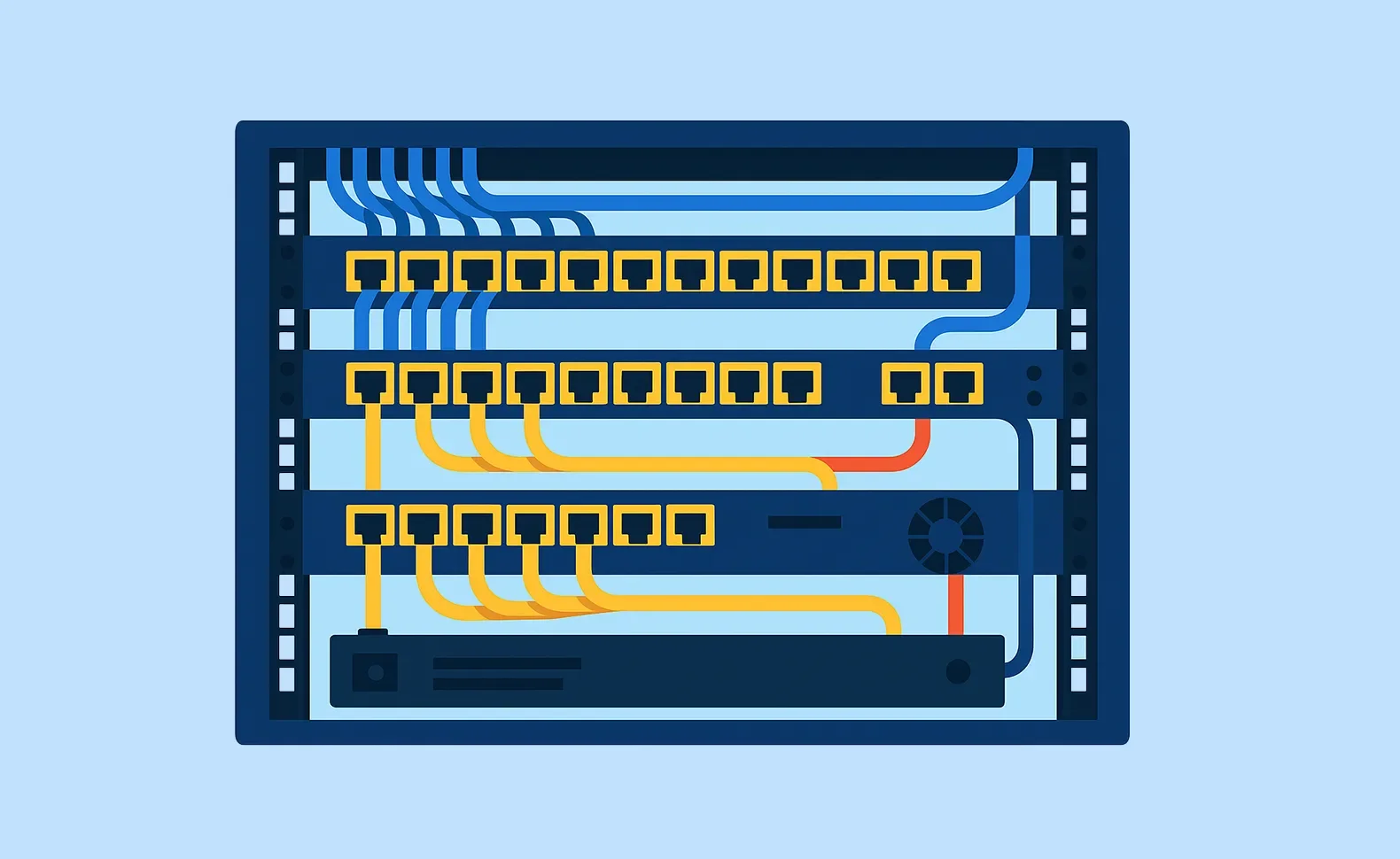
Beyond the Spaghetti: The Commercial Case for Converged Building Infrastructure
By Brendan Mills, National Business Development Manager, SCCI Alphatrack
In the world of M&E (Mechanical and Electrical) coordination, the cable riser is often the most contested territory on a site. It is the silent battleground where separate teams for IRS, Security, Data, and Life Safety systems fight for millimeters of space.
Traditionally, the industry has accepted a "siloed" approach: four different teams, four different cable runs, and four times the complexity. But as buildings become more intelligent and risers become more congested, this model isn't just inefficient—it’s a commercial liability.
1. The Lesson of South Mimms: Solving the Riser Crisis
Early in my career, I worked on the Highways communications system at the South Mimms regional data centre. Over decades, constant upgrades had turned the risers into a "spaghetti" of legacy cabling. There was quite literally no room left for the future.
My recommendation was a phased transition to a Converged Network. By unifying data, security, and IRS into a single system, we didn't just add a new service; we reclaimed decades of wasted space. We cleared the path for a new era of technology by removing the ghost of the old.
This is the exact challenge facing modern MDU developers. If you don't converge your systems at the design stage, you are building a "South Mimms" problem for yourself in five years' time.
2. The 50% Efficiency Rule: More Than Just Cables
When we talk about "Converged Infrastructure," many stakeholders focus solely on the cost of the wire. This misses the forest for the trees.
By running three or four systems over a single cable, we achieve a 50% saving in more than just materials. The real ROI is found in the Main Contractor’s overhead:
Project Management: Instead of managing four separate subcontractors and four sets of site inductions, you manage one.
Firestopping: Instead of breaching and sealing firewalls multiple times, the job is done once, correctly, and with total accountability.
Liability: Health and Safety risks are halved when the number of engineers on-site and hours spent in risers are reduced.
In a converged model, the Main Contractor isn't just saving on copper; they are saving on time, insurance, and risk.
3. Life Safety: The 120-Minute Standard
A common pushback to convergence is the integrity of Life Safety systems. "Can you really run a fire alarm over the same cable as the resident's Wi-Fi?"
The answer is yes, provided you have the technical foresight to specify the right medium. To include Life Safety, we uprate the backbone to burn-resistant fiber with a minimum 120-minute rating. By using high-capacity, multi-core fiber, we create dedicated "lanes" for each service. As long as there is capacity for the service plus spare cores, there is zero compromise in safety. In fact, safety is often increased because the infrastructure is higher-spec and more robust than a traditional standalone copper run.
4. Hardware Synergy: The Power of the VLAN
Convergence doesn't stop at the cable. It moves into the comms room. On a traditional build, you see stacks of redundant network switches, multiple data cabinets, and a maze of power supplies.
In a unified network, we use a single, high-performance switch architecture. By utilizing VLANs (Virtual Local Area Networks), we keep Security (CCTV/Access Control), Building Management (BMS), and Resident Data (Wi-Fi/VOIP) completely isolated and secure on the same hardware.
Reduced Hardware Footprint: Fewer switches mean less power consumption and less heat in the comms room.
Lower Maintenance: One set of hardware to monitor and one set of spares to keep on hand.
5. The O&M Advantage: Ending the Finger-Pointing
The most painful part of any build is the handover (RIBA Stage 6). This is when the "finger-pointing" begins. If the door entry system fails, is it a data issue? A security issue? Or a cabling issue?
By offering a single, converged system, we eliminate the complexity of the handover. Our team draws from a single source of truth for the O&M (Operation and Maintenance) manuals. This reduces errors, speeds up the training for estate managers, and ensures that the building operates as a single, cohesive organism from day one.
The Bottom Line
Whether it's a regional highways hub or a 20-storey MDU in London, the logic of convergence is undeniable. It is the difference between a building that is "tangled in its own past" and one that is designed for a streamlined, profitable future.