Working with Universal
On Tuesday I attended the Working with Universal Event, being a fan of the Universal Resorts across the world and Disney Resorts alike, I went into this event feeling excited and optimistic.
The event was held in King’s House, Bedford and was arranged by the Bedfordshire Chamber of Commerce in partnership with Universal Destinations and Experiences or UDX.
Below you will find the TLDR and the Long Read of the event as it happened, there is great insight and inspiring talks to read, I know I left the event with a sense of awe, even more excitement, anticipation and hope.
Select which route you want to read, but I implore you, don’t miss out on reading the whole thing.
Contents
The TLDR
Universal Is Coming to Bedford — Here's What Suppliers Need to Know
TL;DR from the "Working with Universal" event, King's House, Bedford — 15 September 2026
Bedfordshire Chamber of Commerce and Universal Destinations & Experiences (UDX) hosted the first in what they've promised will be a series of supplier events for the Universal United Kingdom Resort. Here's the essential version.
The headline numbers
- £50bn projected economic impact, direct and indirect
- ~20,000 construction jobs (not all at once) and ~8,000 direct operational jobs once open
- 2031 targeted opening
- 500 acres, a 500-room hotel, and a retail/dining/entertainment complex split into six themed zones
- Planning approval already secured — the first time a private company has gone through a UK Special Development Order and made it to the finish line
Who's already on board
Confirmed contractor partners: Morgan Sindall, SRM, Wates, Bovis, VINCI, Careys (construction), Mace and RLB (consultancy), and JCB (plant). Universal says 140–150+ of its own staff are already based in Bedford, alongside 1,200+ consultants working across the UK.
How the tender pipeline will actually work
- Construction and infrastructure first — this phase is live now.
- Operational categories later — food & beverage, retail, transport, and facilities management will open via RFI, likely a couple of years into the build.
- Universal is centrally cataloguing every registered supplier, and says it'll draw on that database as each category opens.
- Most day-to-day access will run through the named prime contractors, not directly with Universal — Universal's advice: "they're pretty easy to call."
- What they say they screen for: competitive terms, safety and delivery track record, ability to scale, transparency, and genuine community/ESG commitment.
The bit that stuck
Universal leaned hard on stories of small suppliers who grew alongside them — a mom-and-pop chocolatier in Florida who started with an order for 5,000 chocolate frogs and now supplies in the millions; a parking-garage contractor who pitched a new product and ended up building thousands of hotel rooms. The message: no business is too small to start, but the way in is usually a small, provable pilot — not a pitch for the whole contract.
One open gap worth watching
Universal admitted it doesn't yet have a solution for contractor and long-term staff accommodation (potentially ~8,000 people once operational). They're relying on the local market and developers to fill some of that gap — a live opportunity for anyone in housing, hospitality, or related infrastructure.
Bottom line
This is a genuine, long-runway opportunity — but it rewards patience and positioning over speed. Register interest now, get in front of the named prime contractors early if you're construction-adjacent, and if you're an operations-side supplier, use the next year or two to build the case studies and accreditations Universal says it will be looking for.
More "Working with Universal" events are expected — keep an eye on Bedfordshire Chamber of Commerce for the next one.
The Long Read
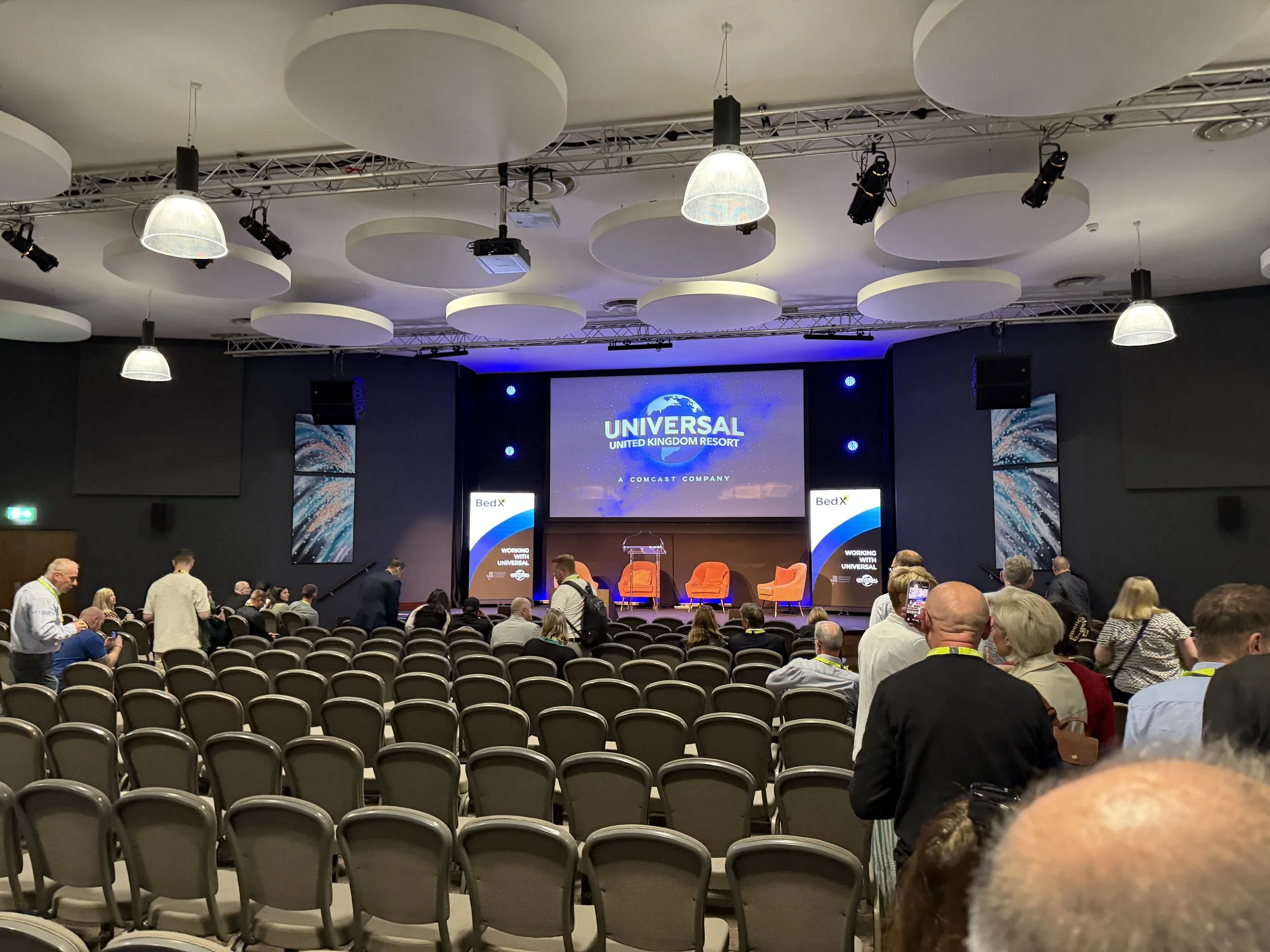
King's House, Bedford — Tuesday 15 September 2026
Opening Remarks — Justin Richardson, Chief Executive, Bedfordshire Chamber of Commerce
It's a real pleasure today to welcome you to Working with Universal.
First of all, congratulations on making it into the room. Honestly, we could have filled this room four or five times over — it's been such an exciting time for people, particularly local businesses.
I guess it's a real, clear sign of the buzz and excitement that Universal landing in our backyard has created for everyone. Every question I get always comes down to one question, and it is: what an incredible opportunity we have in front of us.
Yeah, it's also fantastic, really, to see such a broad range of companies in the room. We have every sector, every size, and every side of the project represented, from the smallest to the largest companies — and it's great to see.
Universal on its own would be transformational for Bedford and Bedfordshire. But alongside the expansion of London Luton Airport and projects such as East West Rail, we have an opportunity to change our regional economy for generations. It is literally a once-in-a-generation project, and quite rightly, everyone should be excited.
Much of your attention today, I understand, will be on the people in the front row — they're the ones you're going to want to hear from, to understand the opportunities and learn how your business might get involved with this project. For some of you, the route will be direct with Universal. For others, it could come through another supplier, a subcontractor, or a partnership that starts with a conversation today in this room.
So I know everyone's incredibly excited to rush next door to meet Universal at the networking reception today, but actually, the person next to you could be the opportunity that's right in front of you — one you can grab now and build on by the time Universal becomes operational in five years' time. So don't ignore the person next to you, because they might be the most important contact you make today.
At the Chamber, we've seen firsthand how one relationship can open doors to many others. Working with the UDX team has already been transformational for us as an organisation, and I know for many of you in the room, it will be transformational too. That might mean a significant contract, a new partnership, the confidence to invest, or the opportunity to take your business somewhere you'd never imagined. That's what this opportunity presents.
I'd like to thank the UDX team for trusting us — it means a lot. I'd also like to take this opportunity to thank some of the people who helped us put today together: Relevant Productions and THSP. Without you, we wouldn't have been able to do it.
There's a huge amount of opportunity ahead, and today is the chance to turn that excitement into practical next steps.
Thank you — and I'll now hand over to the Minister for Tourism, Stephanie Peacock MP.
Remarks — Stephanie Peacock MP, Minister for Sport, Tourism, Civil Society and Youth
Good afternoon, everyone, and a massive thank you to Bedfordshire Chamber of Commerce and Universal for organising this event, and for inviting me to say a few words.
It is such a pleasure to be back in Bedford today, and to see the incredible momentum building around the investment that Universal and government are making. When I was here in June for the announcement of the signing of our agreement, with the then-Chancellor, I was pleased to meet some of the new workers that Universal had already employed on this project. We spoke then about the bold vision for this theme park and resort.
Last month, I convened a round-table event with local leaders, including MPs, council leaders and mayors, to discuss how we could all work together and collaborate on shared goals in areas like jobs and skills, creative industries, and tourism. Coming back today, I can see how rapidly plans are turning into action.
This is one of the largest single investments made in the UK in recent years, and will provide a massive boost for construction, hospitality and the supply chain, through tourism and for creative industries, to name just a couple.
Universal chose the UK as its European home for many reasons, and one of them, I think, is the unrivalled strength, creativity and diversity of British business. Looking around the room today, it's so fantastic to see so many of you from all different kinds of industries represented here.
This government is fully committed to supporting this development, alongside our £1.3 billion investment into local and regional infrastructure. We want to ensure that this project delivers lasting, sustainable benefits for people, for businesses, and for communities in Bedford and the surrounding area, and drives growth for years to come.
So thank you for all being here today, for your expertise and your willingness to work with us to make this vision a reality. I wish you luck as you prepare to be part of this exciting opportunity, and I look forward to seeing the immense, positive impact we will achieve together.
Thank you.
Transition
Thank you, Minister. Next, I've got to invite the Mayor, Tom Wootton, to the stage. Thank you.
Remarks — Tom Wootton, Mayor of Bedford Borough
Thank you so much for choosing Bedford, and coming to Bedford — I think our number one thanks should go to Universal for choosing Bedford, and not somewhere else close by, like Milton Keynes. We are very glad that they chose Bedfordshire, and thank you to the Chamber for organising today.
I am so pleased you're here, because it's the start of things. It starts with every question about how we're going to work with Universal, how the jobs are going to be local, how we're going to make things work. There's such a short time before this opens — there's got to be a huge workforce, and it's got to be ready, and it's got to be there, and everything's got to be going, because our whole national identity — that we can actually do business — is on the line.
Everybody's looking at this area, saying: can we do big things in Britain? Well, we can. And I'm determined that, here today, we can say: yes, we can.
Now, as Mayor and as a council, I'm really proud of our council workers who have had a hand in this. But also of our efforts as a council to be a "can-do" council — a council that can help not just with planning, but can help provide workshops, yards and space. We have a lot of space — probably not where you live, but we have a lot of space allocated for that sort of light industrial use, and all the units you're going to need.
In about three or four weeks' time, I'm cutting a ribbon — you know, mayors do like cutting ribbons — on a 12-acre site just north of Bedford, that's going to be one of the largest pallet factories in Europe. We can do big things — in fact, instead of just cutting ribbons, I also like cutting red tape.
So I think if we carve out a "can-do" council, we can make things happen — come and talk to us, we've got council workers here. If you want to come to Bedford, we're open for business.
Thank you very much, Universal, for choosing Bedford, and thank you very much for coming to this lovely venue — and I think let's give credit where it's due.
Thank you to the Minister, who has a really busy schedule — you know, everyday life as a minister is rushing from one place to another — she has made time to come to Bedford several times now, and I'm really grateful.
So, ladies and gentlemen, thank you all, and thank you to our Minister.
Remarks — Laura Church, Chief Executive, Bedford Borough Council
And now, Laura, Chief Executive, Bedford Borough Council, just a few words.
Thanks.
So, firstly, thank you to Justin and the team from working with Universal on getting today off the ground — a great achievement, and great to see so many of you in the room. And thank you, Minister, for your third visit to us in a very short space of time — so good to see you again.
I'd really like to echo the message from Mayor Tom, and welcome you to Bedford Borough. The new hashtag you're going to see is #HomeOfUniversal — so start using that.
We've been really excited about the opportunity this creates for our place and the wider region. But now the challenge is on for us, collectively, to make sure that we're embedding those benefits for generations to come. So this is really your chance to engage and look at the business opportunities, but I also challenge you to think about some of the things that will make a lasting difference.
So, even as you — and I agree with Justin on this — think about who's sitting next to you and who you've worked with, could you also inspire young people to think about different career opportunities? Could you offer an apprenticeship? How could you work with your supply chain to really make a difference, so that we're creating lasting change here? Could you employ someone who has been in care, or who is looking after a child? There are lots of opportunities to really think about what we need to do.
We will continue to work with Universal and the government to make sure this works, whether that's infrastructure or working with colleges and universities — and I'm very pleased to see Anna here from Bedford College on the skills side. When the Tourism Minister was here talking to local authority leaders and chief executives a couple of weeks ago, that was a big feature of the discussion.
Our role as local authorities is really to facilitate, enable and encourage working in partnership, and to be ambitious for our places. Like you, we've had to pitch for this investment, and I'd like to think Universal thought our location was fantastic — that's obvious — but also that they really welcomed our ambition, our passion, and our drive for Bedford Borough, and the difference we would make.
There is, rightly, a lot of excitement about Universal in Britain. But the real test — and I want you to take this away with you — is whether we can really make a difference: whether you can win contracts, and whether you can support opportunities for young people and skills programmes.
So today is really about more than showcasing our ambition. It's about sharing a shared understanding, doing some networking, talking to each other, and then thinking about the practical next steps. I'm very grateful to everyone who's helped bring this event together, and to all of you for giving your time. I hope that today's discussions are open, constructive and ambitious, because Bedford, Bedfordshire and the wider region has a major opportunity in front of us. We will only make the best of it if we work together.
The reason I brought my little prop is — if they can make it work in Hollywood, Orlando, Japan, and Beijing, let's make sure that Universal UK is able to have the biggest positive impact on residents and communities.
Thank you, Laura.
Introducing the Universal Team
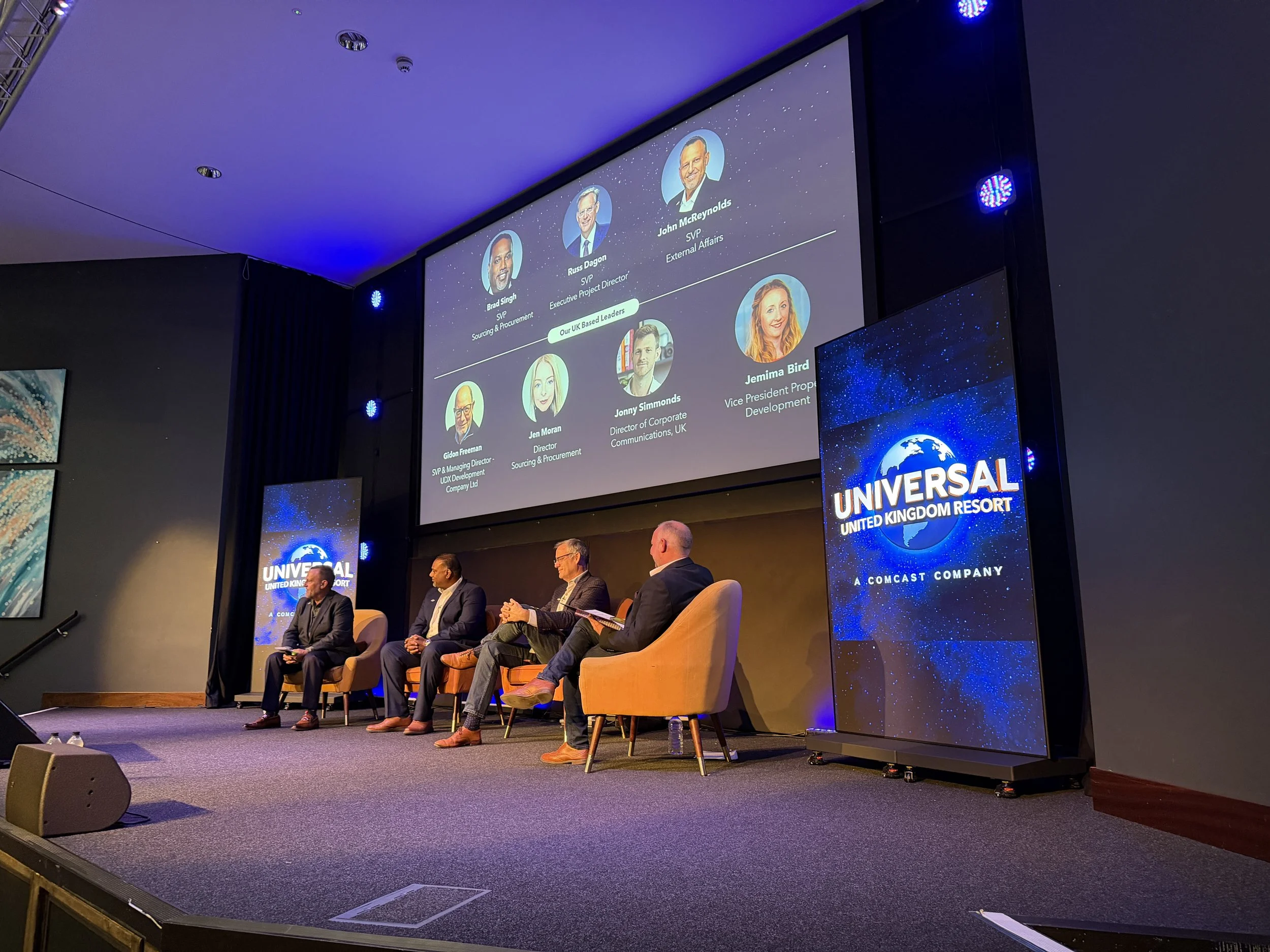
Sorry — I know it's great to hear from you, but I think the audience are really excited about some American accents!
And now, the moment you've been waiting for — would you please give a very warm welcome to Brad Singer, Senior Vice President, Sourcing and Procurement; Russ Dagon, Senior Vice President, Executive Project Director; and John McReynolds, Senior Vice President, External Affairs, to the stage.
Now, wouldn't you be surprised if I started speaking with a British accent? Gents, it's over to you.
Presentation — John McReynolds, Senior Vice President, External Affairs, Universal Destinations & Experiences
Incredibly exciting times. I understand there are things you want us to speak about — should we start there, rather than jumping straight into questions? Just a bit of background on why we're here, and what's next.
So, I get to kick this off. I've been one of the longest-running executives in the company. In fact, I was able to share with the leadership of Bedford that, before anybody knew we were coming, I brought my poor wife here and made her drive 350 miles, covering every road in Bedford — true story — and then made her walk 13 miles around the entire downtown.
I do that for a reason: before we ever go into a community, I want to know the feel of it. I want to know the likes and dislikes — you can tell a lot by just spending time there with nobody knowing you're there. And that's how it all begins — the journey begins. In this case, what I saw was just an unbelievable opportunity.
So as we go, I'm going to introduce a couple of folks who are up here, as's just been said. We have Brad Singer, head of procurement — no pressure — and Russ Dagon, who is the one who gets to deliver this project on time, on budget. That was the secret, though — no one was supposed to snicker when we said that.
And now that I have the pleasure of dealing with the government, I'm the person nobody really wants to see, because if you see me, it usually means there's a problem. You want me to go spend my time elsewhere!
But in all seriousness, it starts with our local team. Ben Freeman, up here — I'd like to get our team to stand up and say hello. Ben Freeman is our SVP... stand up. Jen Moran — Jen, please stand — is our Head of Local Programme. Johnny Simmons, where are you, Johnny? He has to deal with way more than he should, at all hours, with me — and also under pressure with utility infrastructure, creating the amazing platform for us to build this site. Dwight Byrd, our Vice President of Property Development. And I'm not going to leave out — even though she's not up here — Rosie, please stand up, and Becca as well, who works alongside Johnny.
I would be remiss not to start with a huge thank-you to the Borough Council, the Mayor, and the staff. When you deal with an international company of our magnitude, it is not easy — there are certain demands, certain commitments we want from a local community — and I will tell you, every single time, they rose to the occasion. This community can do it, Mr Mayor.
I also have to praise — and I know the Tourism Minister is here — I have to praise the national government. They've been phenomenal, all the way from the previous administration — and by the way, this really started under the administration before that. In fact, I don't know how there could have been any more changes of political leadership in the middle of a project like this, but unanimously, every single political party supported us.
There were times when we were right up against it, and I wasn't sure — I was telling the Minister this story: I was sitting at the Metropolitan Club in Chicago, on the top floor, looking out on a snowy December day. We'd just come from a point where we weren't sure we were going to get over the line. Literally, one phone call — unbeknownst to anybody — is where the final number was sealed. That was about a week after we'd met with the Cabinet here. So that shows you that everybody rallied and really took us to a different place.
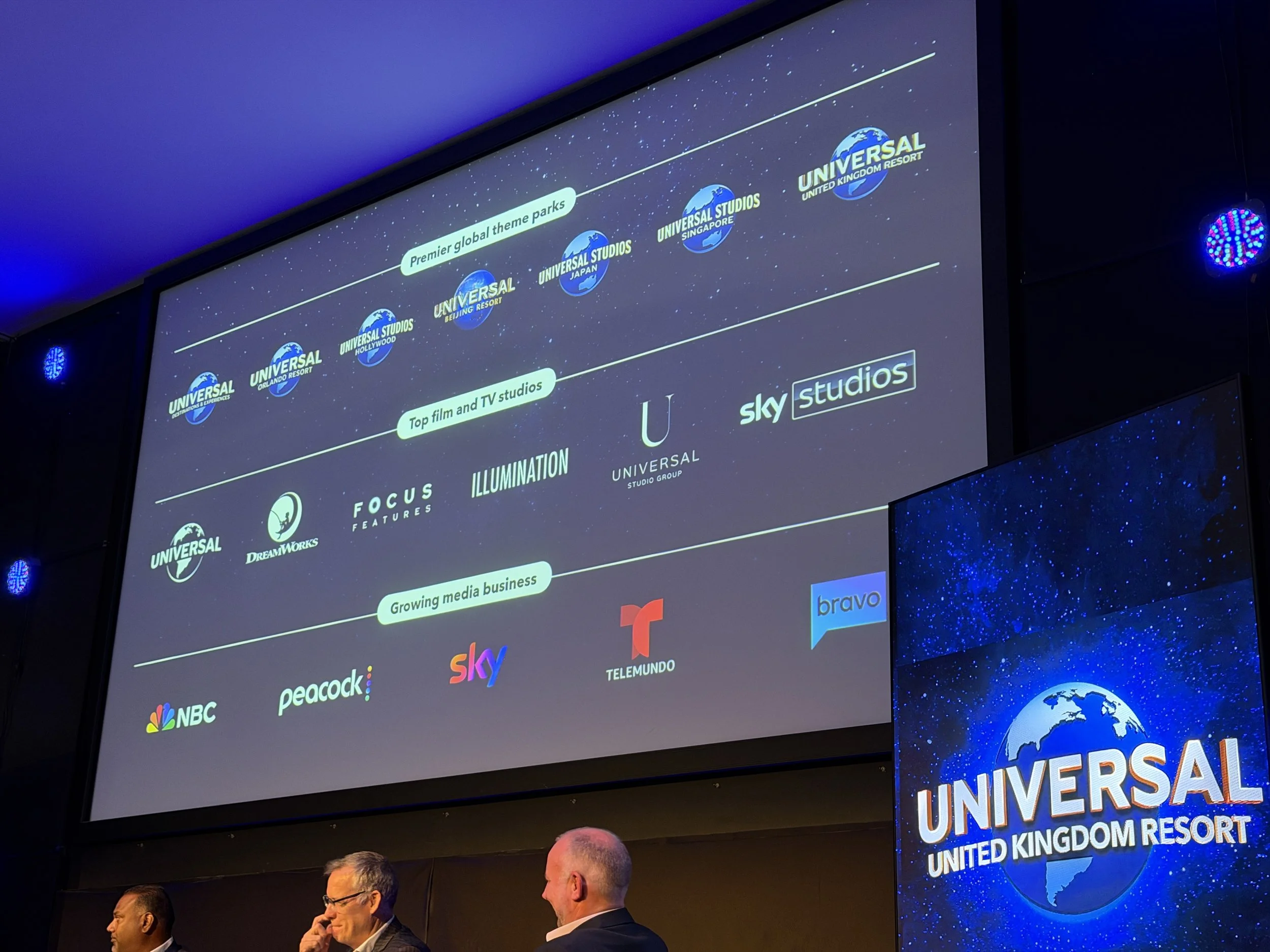
And part of that is who we are as a company. We're a premier global theme park business, but we also know the UK business climate — thanks in part to one of our sister companies, Sky. Comcast, NBCUniversal, owns Sky. So they're able to give us the lay of the land, and some good insight — because even though we all speak a common language, there are cultural differences, and that helps us bridge that gap so we understand the process.
You'll also see many of our top TV and film products here — many of you know that Wicked was made here; that's a Universal property — and you'll see some of our networks further down. We're excited because we bring the whole of this company to this marketplace, so you see the globes on the map.
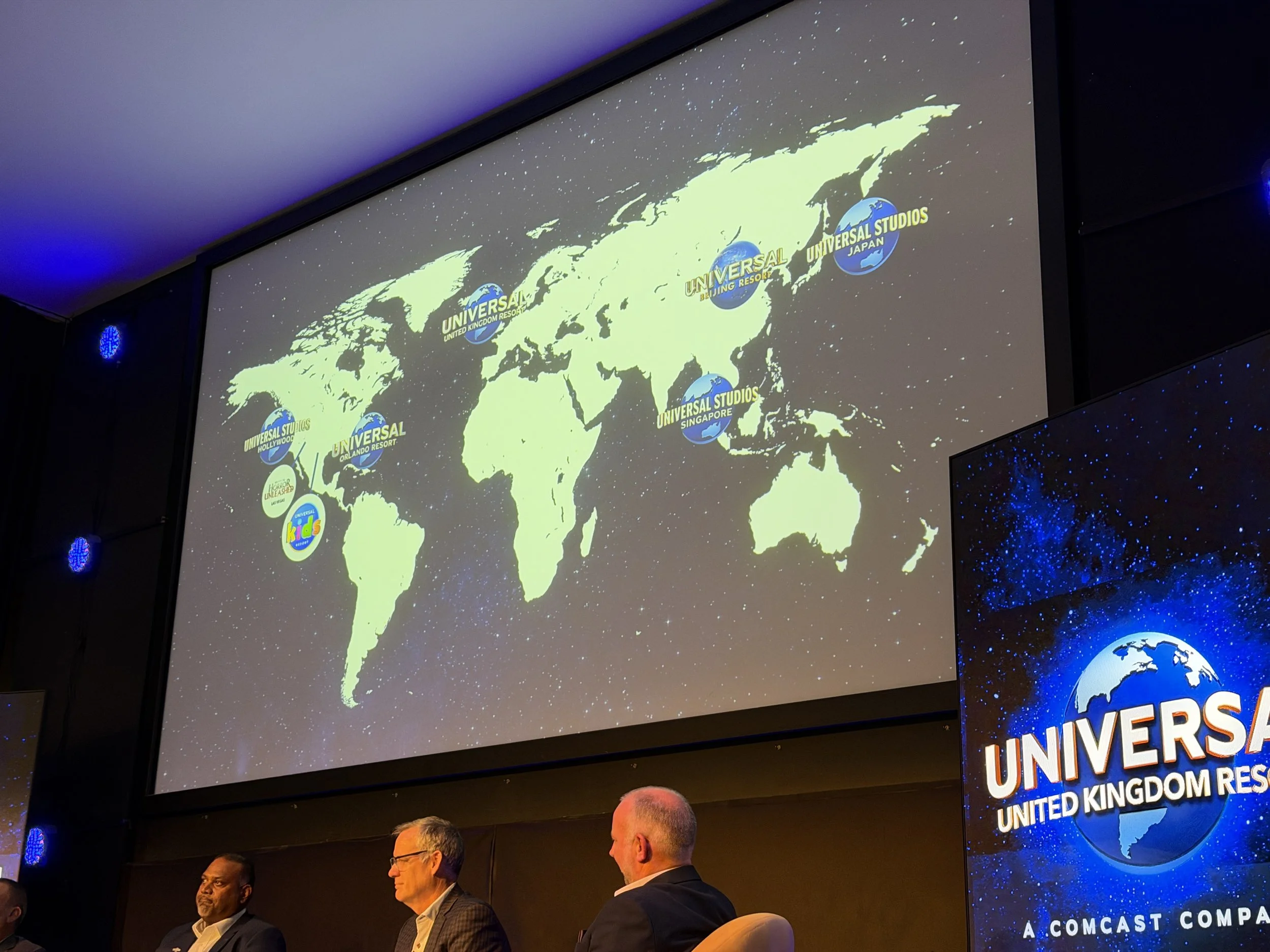
When we first started this project, before the commitment had been made, the Mayor will tell you there was no Universal United Kingdom Resort on that map — there was just a big empty spot. And I get to tell you why that matters. Whether you're from here or from outside the area, you need to understand the dynamic of what we do, because — as you sit here today trying to learn how to do business with us — this is much bigger than anything you have done before. So you can see the other locations on that map.
And by the way, you'll see Beijing there — we opened that in 2022. I'll tell you, that is not when you want to open a theme park in China, in the middle of COVID. I had the honour, in 2020, after everything had shut down — nobody wanted to get on an airplane except, I guess, this guy with grey hair — of carrying 400 US passports myself, because I wasn't about to ship them. With Washington DC completely closed, I made my way to the Chinese Embassy, where a Chinese guard looked at me and said, "What are you doing?" And I said, "Don't worry, the Ambassador is expecting me." We were the only company in the world that was actually able to get our people back into China during the first year of COVID. We got that park open — we got it open in 2022.
You see our latest resort — that's our most recent opening, Epic Universe. What does that mean? It means that, in our industry, we're the only company in the last decade or two to have stood up multiple entertainment resort complexes, as you see on this map. Our latest — a smaller product — is our Kids Resort in Frisco, which has now been open for a couple of months; we only just launched that.
So here we are — the first Universal theme park and resort destination in the UK and in Europe. You will not hear us call this a theme park. You've got some great theme park operators in this country, you really do, but none are our peer, because of the immersive environments we create with our entertainment resort complexes — that's a different product. We have one competitor worldwide, and I'm not going to name them, because they've got a 20-year head start.
So, one of the largest-ever investments — you heard the Tourism Minister mention that — we're very proud of that fact, because we didn't just commit to a day-one spend, we committed to a ten-year spend after that. This is not a static product — we don't do static. A 500-acre parcel of land, fast rail links to London, well connected to the rest of the country.
There's a train operator I'll leave nameless who we've been working with. When they first heard about our passenger numbers, they looked at me and said, "We're going to have to sit down and run the numbers again." My response was, "I'm sorry — am I bringing you too much business?" But, you know, someone else at that same company said, "We'll do it."
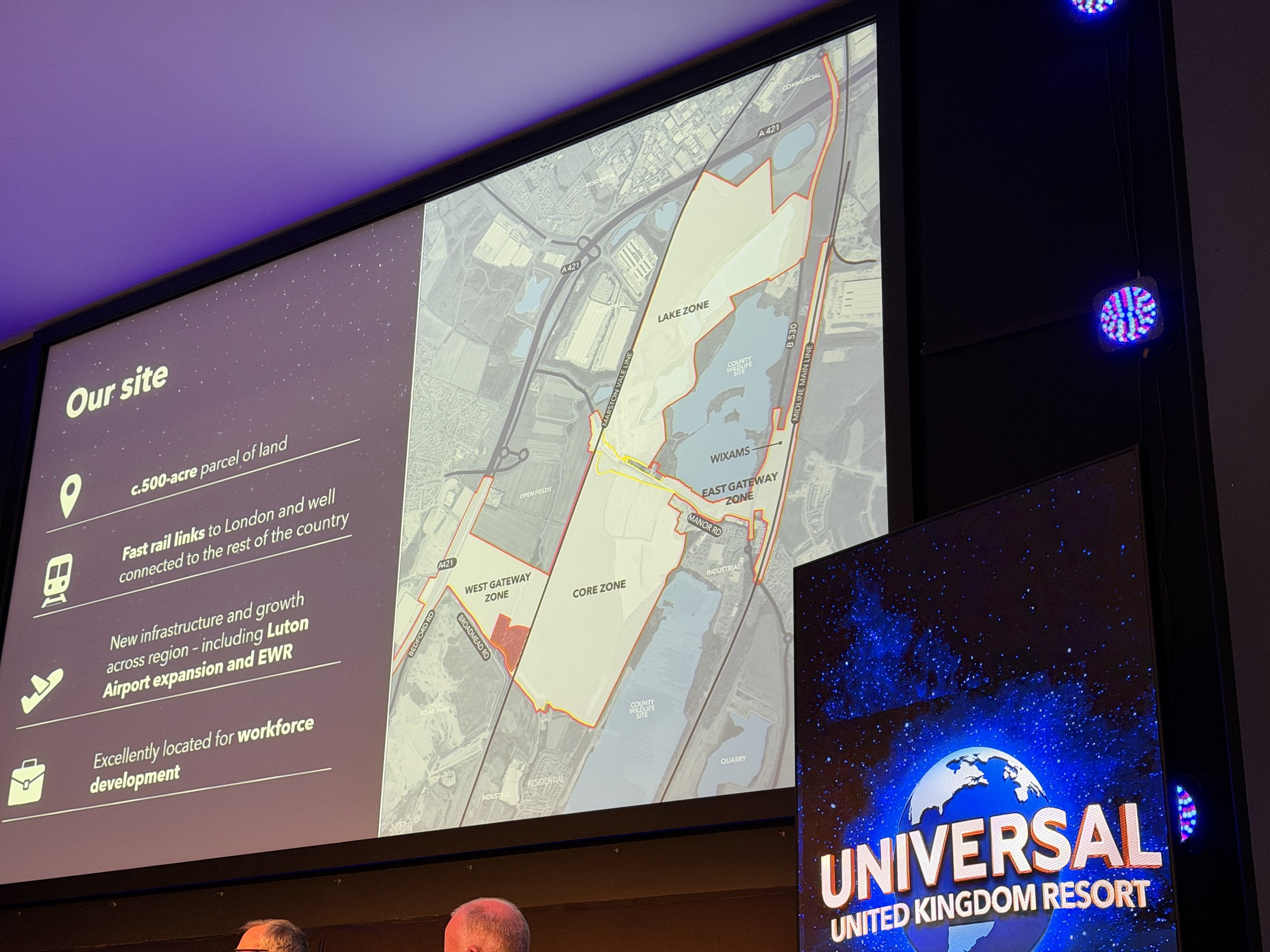
You see the new infrastructure and growth across the region — we've already been working very closely with London Luton Airport, sorry, the Luton Airport expansion. Why is that important? Because we take a total view of the guest's journey. What does that mean? I know our guests get on a plane to come to us. I want to know what that experience is like when they touch down. I want to know what it's like for them going through security or border control. I want to know what it's like on the roads or the rail to get to us. I want to know the experience they have on our site. I want to know what partners we have in the community. And I want to know they're going to have a seamless experience getting back on the plane, too. Why? Because repeat visitation is key — it's about the whole journey, start to finish.
In the last ten or fifteen years, we've sent our people into Orlando International Airport three times to help redesign their queuing, so we could do it fundamentally better. And we're always welcome, because we're the experts.
Excellent location for workforce development — and that is real. You have a wonderful workforce here that's ready to grow, and a wonderful education system that's ready to build what's needed for the next generation of opportunity. That excites me — I really can't say enough about it.
There's a reason why our first two community days were held at two colleges. It wasn't because they had the biggest space — I could have put this anywhere. It was to send a message about who we are, and who we work with when we come into a community.
We will initially include a world-class theme park, with several themed lands, a 500-room hotel, and a retail, dining and entertainment complex — innovative attractions, exciting entertainment — Johnny? But the last line there is what I want you to focus on: our planning approval is already in place for potential future expansion. I don't have to go back and get more approvals — I don't have to go back.
We continue to work with MHCLG, and they're great partners, and we'll continue working with them throughout the whole process. We needed a level of certainty to make this multi, multi-billion-dollar investment — we needed the certainty that we could keep growing.
Take Orlando, for instance — granted, we have three parks there, and we're a little more mature — but every eighteen months, I put up the equivalent, in capital spend, of a skyscraper. I've got to make sure I can keep reinvesting in this product with vendors like you, so I'm constantly keeping it fresh.
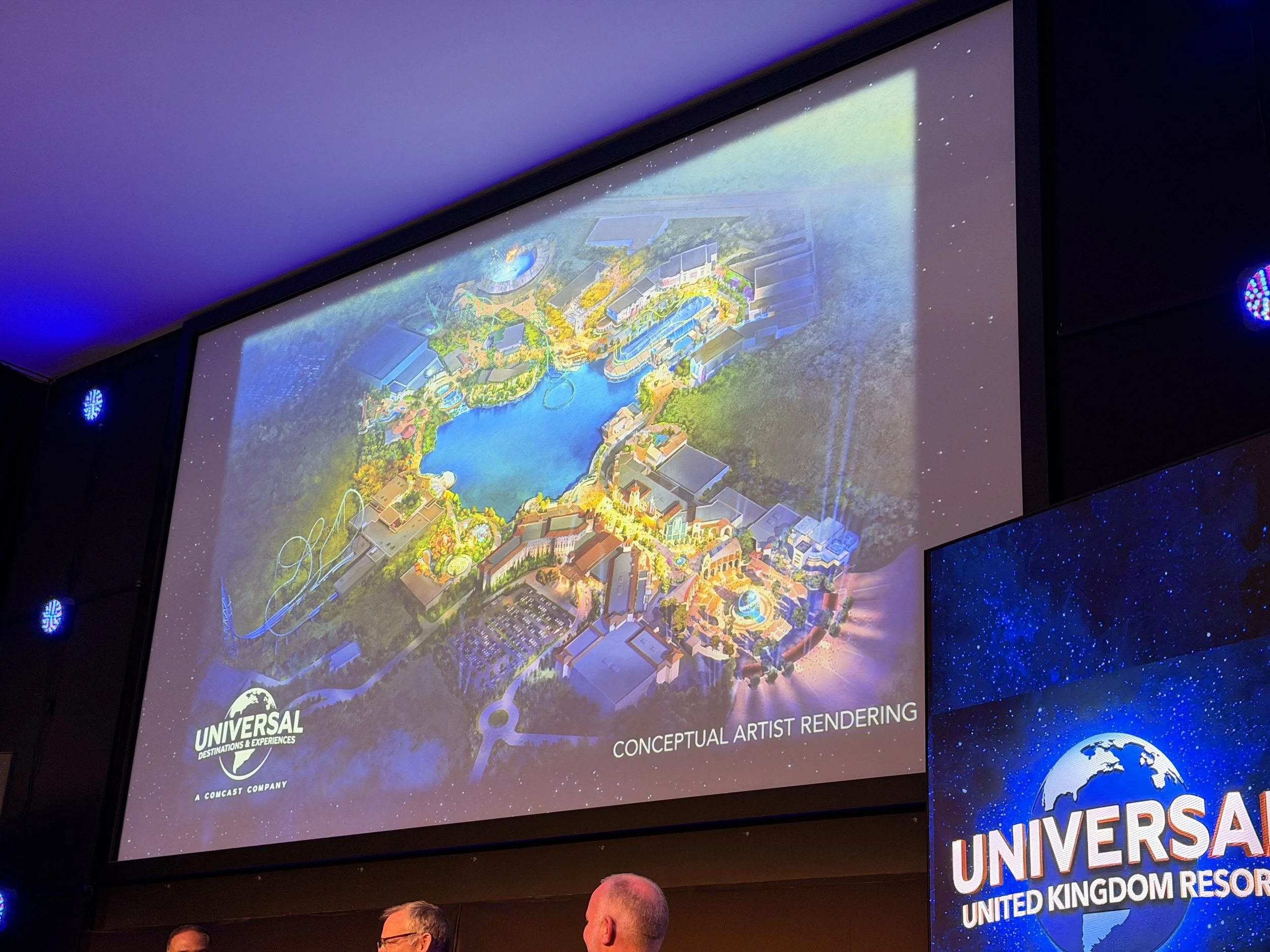
[to colleague] Can I talk a little about the bird's-eye view? Yeah — so this is something you've probably all seen already, of the product we're going to build here. It's a little vague, so you can't see all the IPs we're working with, so I'd like to tell you what they all are.
What I'd like to point out — as I was talking about earlier — is that we've got some green space there, and that green space, I'll be honest, isn't that green today, but that's the future opportunity for the park's growth as we continue to reinvest. We've got expansion lands, so we can expand with more rides throughout the entire park. We also have expansion opportunities within each land — a new attraction, on whatever basis the programme calls for, as we move forward.
So that's part of the challenge of the design process — creating an amazingly full experience for year one, while, a year or two out, before we're even ready to open this park, we're already working on the expansion property to figure out what we're going to have next. We did that with Epic Universe — it opened the summer of 2025, and we're already under construction on the next attraction there. So that's a great opportunity.
You know, the park isn't just this core zone — we've got the Lake Zone to the north, we've got the Western Gateway, all of which present expansion opportunities as well.
I should point out, we've got some key contractors we're working with already — Morgan Sindall, SRM, Wates, Bovis, VINCI, Careys are all on board and working with us through the design, and getting ready to start the tendering process right now. And that's what a lot of you are very interested in.
And in addition to that, Mace, RLB have been working with us for several months, helping introduce us to others in the wider community and basically teaching us the rules of the sandbox. We fully recognise that we know how to develop theme parks, and we're very good at it. We also fully recognise that we're playing in a different sandbox right now, and we have to understand the rules. So we're here, embracing that. It's been a great process so far — I can assure you we're learning something new every day. The pace is different from what we may be used to.
I'm guessing most of you here probably don't have a lot of theme park experience — every one of us on this stage was in that exact same position at one point. With every vendor we work with, in every one of our locations, there's a bit of a courtship: vendors come to us and say, "I've never done a theme park before," and we have to explain — well, if you've worked in manufacturing, it starts to look a lot like what we do. If you've worked in retail, that looks a lot like it too. And honestly, if you've done hospital construction, you're used to a lot of the systems and infrastructure that go into the facilities we build.
So there are so many parallels between what you all do and what we're looking for. That's refreshing, and I don't want any of you to think, "Well, I wouldn't qualify" — because that's 100% not the case. Every one of the firms I mentioned, we had that exact conversation with them at first.
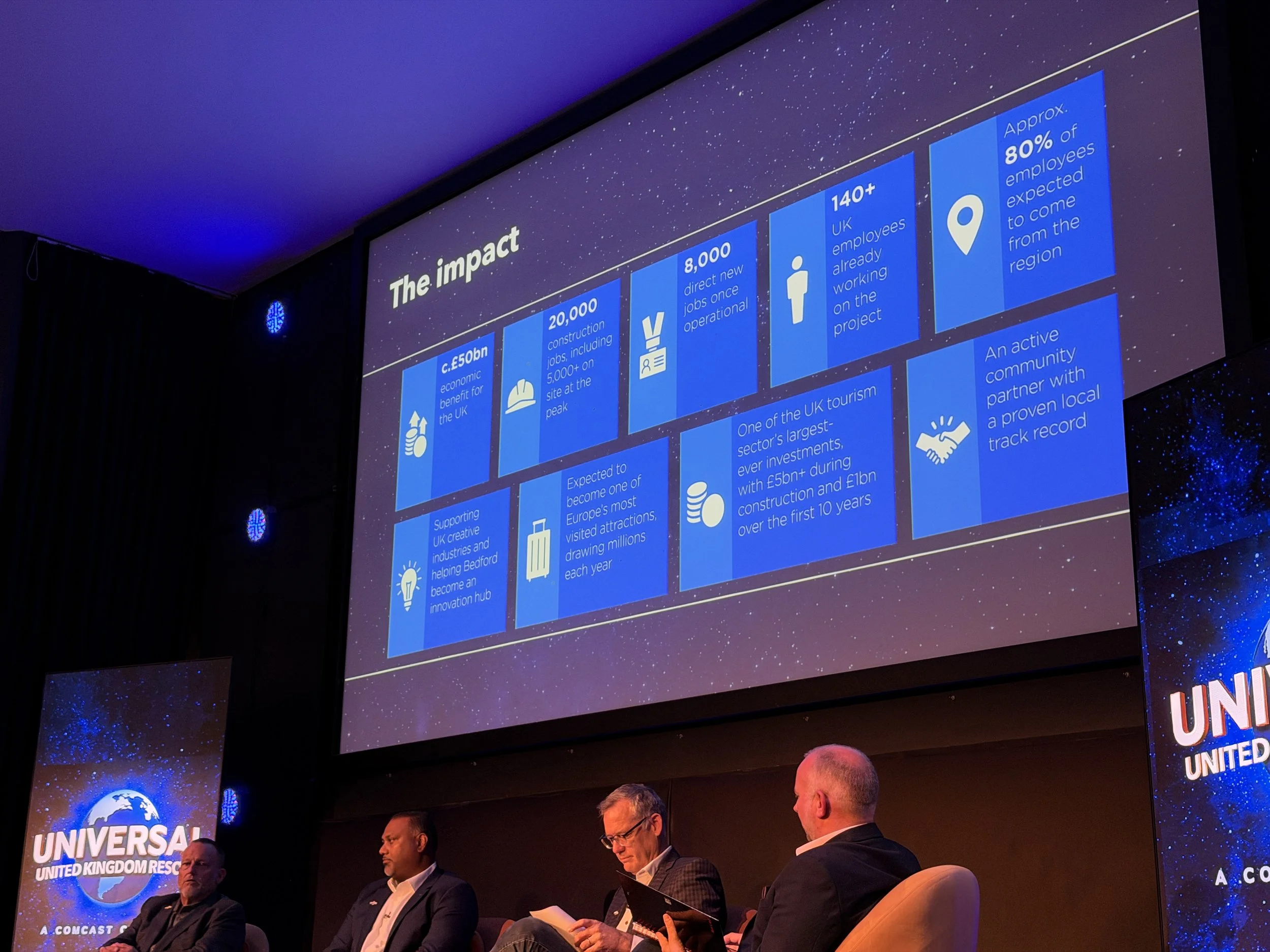
So these are just some of the numbers you've heard. We've had the analysis done, and it's been written up and approved by the government — a £50bn impact, both direct and indirect. You see the 20,000 construction jobs; that's what it's going to take to get this thing built. Now, not all of those jobs happen at the same time, but 20,000 construction jobs will be created. You see the next number — 8,000 direct operational jobs — and that doesn't even include the multiplier effect; the indirect number is typically about 1.5 times that. So we're also talking about 20,000 direct and indirect long-term permanent jobs, which is where, again, the wonderful education system comes into play, so we can continue to hire and create generational impact.
And by the way, we really do believe that. You'll hear people say, "Well, they're just paying for ticket-taker jobs" — nothing could be further from the truth. We have unbelievable benefits, and it's an incredibly upwardly mobile industry — one of the most upwardly mobile out there. You can start out sweeping the street and end up CEO of the company. There aren't many industries you can say that about, and that's serious.
I'd like to add here — when we looked at that map, you saw the park is broken into different zones. We've got six different zones across the park, and each one is managed by an individual land director. Two of the land directors on this project started with me as interns — they've just come off several hundred-million-dollar projects they delivered on Epic Universe, and now they're at senior director level, leading teams on this park.
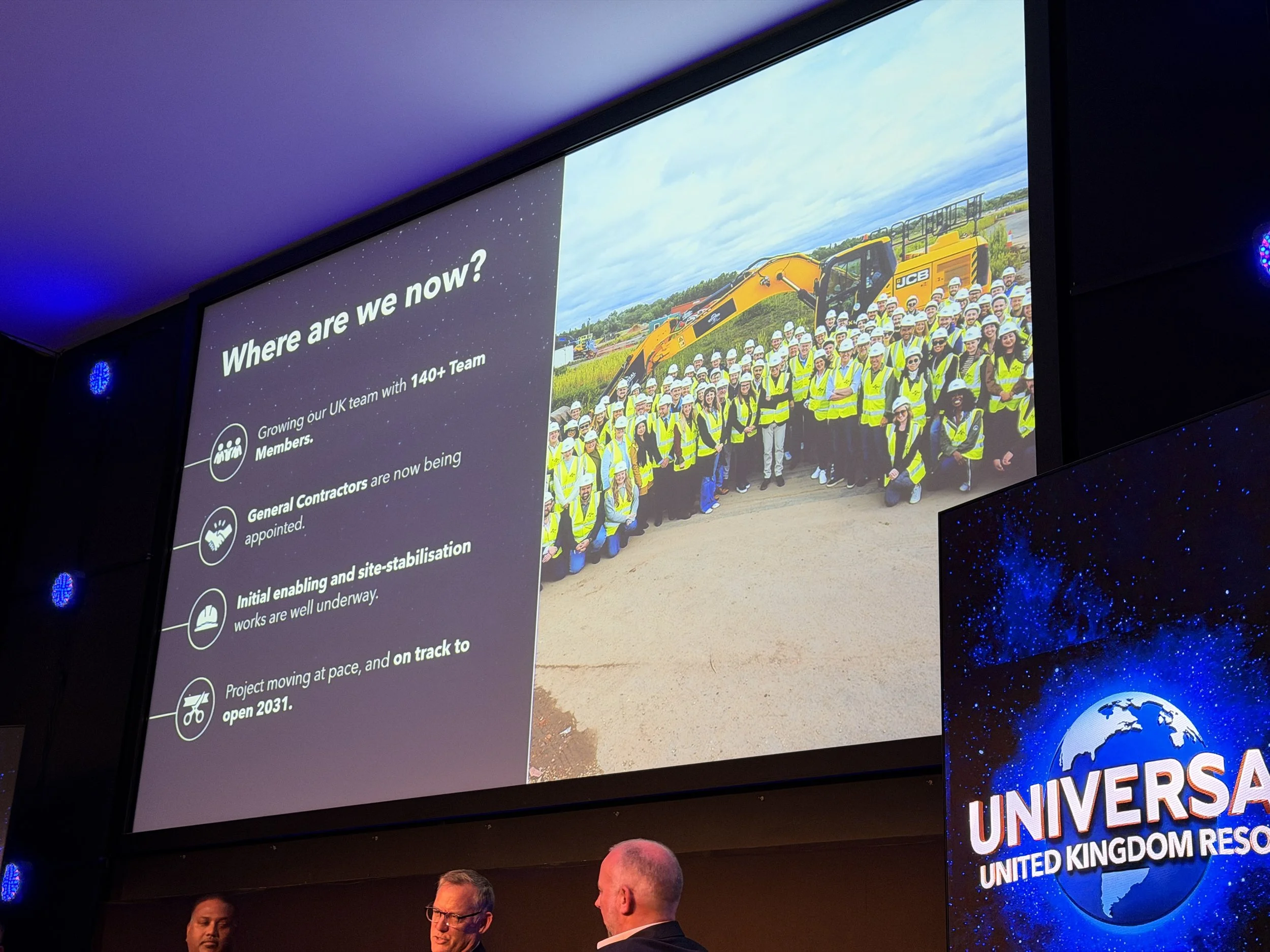
You can see here we've already got 140 to 150-plus members of our team here in the Bedford area, plus another 1,200 consultants working across the UK. So it's already started, and the one thing we know is what our guests — so please, help us out and deliver on what we care about.
Again, we can't thank the Borough enough. We opened our offices on the sixth floor, and now on the ground floor. [aside] We did that intentionally, to send a message that the Borough had space there, and to show that we're going to invest in the community. We could have gone to an office park — there are a couple of places we'd have loved — but it was also to send a message. We want to become Europe's most-visited attraction, for millions of people to come and see, but that's only going to happen if we work with the community, in every way.
It's one of the largest-ever investments in the tourism sector — not just the largest in the UK. And we want to be an active community partner. What does that mean? You're all here today wanting to be vendors with us on the development or the operations side, but some of the things you might not even think about — we're going to want to work with the local food bank. Why? Because part of what's left over every single night in my park is perfectly good, but I won't put it out the next day.
In Orlando alone, Second Harvest is our food-bank partner there — every single night, a refrigerated semi-truck pulls out with food items that can be used for community good. Those are the kinds of things we can do to make Bedford and the wider community an even better place.
And again, the creative industries — one thing the UK has is incredible creative industries — we can't wait to tap into that; we're excited about it. [to colleague] Want to talk about that? Yep, all right.
So, just touching on this again — the 140-plus team members, and the general contractors we're already working with. One thing that's been really interesting is working with younger people, and the training programmes we're going to need in our field. Training the next generation of leaders in our industry — construction and design — is something I think is important to everyone here. It's been fun: so many people compare our project to London 2012. Everyone thirty-five and over in this industry has told us what they did for London 2012, and everyone thirty-four and under is thoroughly sick of hearing about it! So this is the opportunity for that younger generation to get in on the ground floor of something that's really going to be special.
I'll focus on that last point — we will open in 2031, right? I say that because, you know, the government did their job — they put us through a Special Development Order. We're the first private entity to go through an SDO and get to the finish line, and it's not for the faint of heart. We got our planning approval in just under two years, which, in this country, I know is remarkable. It was an abbreviated process, but it was still 12,000 pages — I'm not sure many other companies could have afforded to put together an application that size. And I've got to give MHCLG credit, because they read all 12,000 pages. I'm not sure they'll ever want to do another SDO again! But kudos to the government for stepping up and putting us through that process, given the scale of this investment. So we'll hit 2031 to honour that commitment and the infrastructure — that's just what it is.
So I'm going to let Brad and Russ talk a little bit, and I'm going to share one story if I can.
And that is: we don't care how big or small you are — we really don't, okay? The story we always share is from when we opened The Wizarding World of Harry Potter, and we thought: chocolate frogs are in the movies, that would be kind of cool — let's see if we can sell some chocolate frogs, in the Florida heat! And, um, at a fairly high price point, you'd think. There was a local mom-and-pop chocolatier, and we said, do you want to give it a try? We're just going to experiment and see how they sell — we didn't know if they'd sell well in the hot Florida sun, or whether it was just novel because it was thematically tied in.
So we ordered 5,000 chocolate frogs. They sold out in under an hour. We went back to this couple — who I think had one or two children — and said, "Congratulations, we need 10,000 by Friday." True story: the wife almost had a heart attack. The husband — probably because she was the maker and he was the business guy — said, "Absolutely, we'll do whatever it takes," because they very quickly realised it wasn't just about 10,000 — it was 10,000, then 100,000, then another 100,000, and now it's in the millions that we've sold. And they've scaled up to handle that and grow with us. We're not afraid to do that.
I'll also point out — in Frisco, at an event very much like this one, a local chef volunteered through his local chamber and brought some pastries, to show us he could produce a product or two for our Kids Resort. We do a bit more just-in-time delivery there because it's smaller, more of a prototype. That chef has now taken on an additional five or ten employees, and delivers two of our pastries to the park every single morning. If you're willing to try, willing to build, we're willing to take a chance on you too — as long as it's something we need.
So, Brad?
Yeah. Thanks, John.
Presentation — Brad Singer, Senior Vice President, Sourcing and Procurement, Universal Destinations & Experiences
So you could say the chocolate frogs were jumping off the shelves.
So, I get to talk a bit about doing business with Universal UK. I'll start by saying probably one of the most rewarding things I get to do in my role is these events. Inevitably, at almost every location I've been to, there's a "chocolate frog" story — a supplier who started in one park we own and is now working across the world. In fact, we'll show you a QR code at the end of this, and we made the decision to put a checkbox on it asking, "Are you willing to share your information across our global parks?" So certainly, Universal United Kingdom is the immediate task, but there's a whole universe of opportunity beyond what we're doing here.
It's interesting — last Friday, I was at an event hosted in Orlando, and a gentleman came up to me. He owns a scaffolding business, and he said, "Brad, I just want to thank you." I said, "Well, you're welcome, but I don't know for what." He said, "Brad, through the Epic Universe project, I've quadrupled my business, and I had no idea it would happen." But the way he did it was by working through a general contractor, through a subcontract, tiered down through the supply chain.
So, for us, local isn't just something we commit to here — it's what we do around the world. There are plenty of stories like that at all our parks. In fact, the best example of that commitment is our local hire team. One of the first things I did in this organisation was to say, "I need to hire a local Director of Sourcing and Procurement," so you'll be seeing a lot more of... and Jen as part of the broader team as we build out the theme park here.
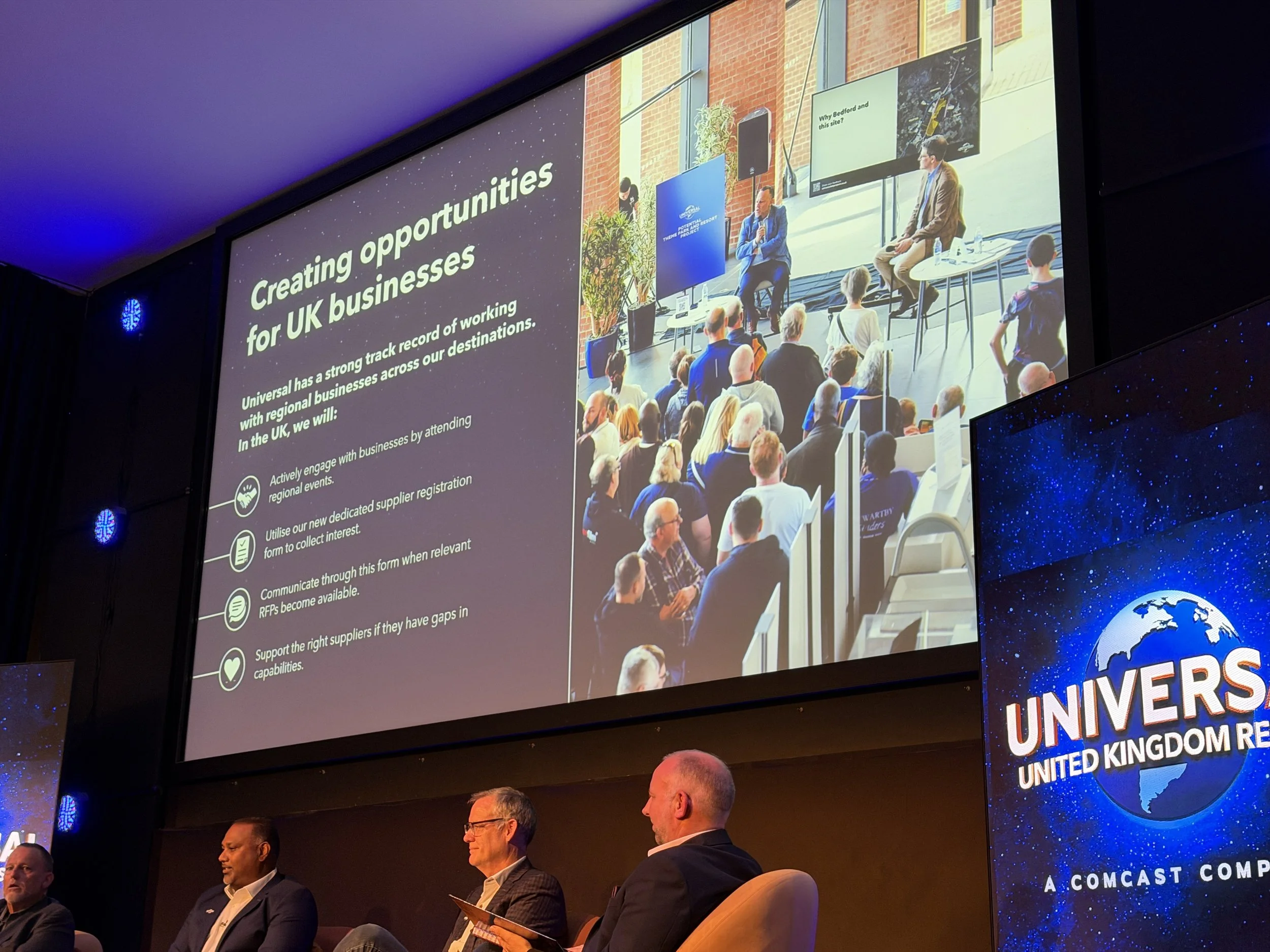
But what can you do to help work with Universal? Attend these events — that's a big part of what we'll be doing throughout this programme. You might say, "Look, I'm a vendor in this category," but the opportunity may not be immediate. We've had a lot of people say, "Brad, we can supply everything from retail to cotton candy" — but we need to build the park first! So you'll see the natural progression of the timeline starts with construction, then moves into the other elements. I mentioned our dedicated supplier registration.
We don't want the timeline to dampen your interest — so what we'll do, as a team, is catalogue all of the interest we receive. As we have RFPs going out in different categories, we'll be tracking that interest, cataloguing it, and sending out tenders. As John mentioned, no business is too large or too small. A lot of the time, people in the construction industry think a big supplier means a big contractor — but it's amazing how many small and medium-sized businesses come together to build and operate a park. In fact, if you look at our vendor base, I think you'd find it's made up of more small and medium-sized enterprises than large ones.
[aside] Tony, on that last picture, we need to do some serious editing on that guy in the front — [laughs]
So, as I talked about opportunities at this stage — clearly what's ahead of us is construction, civil engineering, everything around the facility. And in fact, we've come to the UK with some partnerships already in hand. Not surprisingly, as a big resort builder — JCB, the fine firm here in the UK, we were actually a huge customer of theirs in the US. And you'll see a lot of these partnerships, which started as global relationships, also turn into local ones.
Infrastructure, utilities, transportation, food and beverage — when you have that many contractors on site, they need to be fed — landscaping, facilities management, and a whole host of professional services. Clearly, as John mentioned, we have sister organisations here in the UK, so we're going to leverage the scale and strength of Sky and others. But those sister organisations don't operate a business quite like ours.
So we're really excited to meet the people in this room, to understand the capabilities you can offer us, and to help you scale. In many cases, we've found even the smallest suppliers — we've helped them get there, whether through introducing partnerships or being flexible on some of our terms and conditions. We're happy to do that when we see the right fit.
So, what do we look for? You'd expect me to say competitive price, wouldn't you? But when we're at a crossroads of delivery, all of this is taken in context. Clearly, commercial terms are super important. Health, safety and performance too, given we're building a complex resort structure with lots of moving parts. And our commitment to the community — ESG, social responsibility — is at the highest level as an organisation. I personally get to support organisations like Second Harvest, and I chaired the Special Olympics for the State of Florida for thirteen years.
What we do for the community, and the impact we make on our local supply base, is part of who Universal is — it's part of what we bring to the market, and we're excited to keep doing it. To give you an idea of the size of that commitment — again, using Florida, which is a more mature market — last year alone, our staff put in 70,000 volunteer hours in the community. That commitment is very serious, and we want the people we do business with to share it. We really want to focus on that community.
So what else do we look for? Delivery at scale — John talked about the chocolate frogs, and that's about scaling to meet demand. As we talked about, it really means partnering with the group and bringing things together. Transparent reporting and supply chain management, too. A lot of people ask me, "Brad, what's your key focus for suppliers?" And I'd say transparency, timeliness, and balance. I tell my team — I've got an acronym: AIR — Attitude, Integrity, Respect.
When you're doing these ambitious projects, you need a positive attitude, you need integrity, and respect for the people around you. And that's the same thing I look for in our partner suppliers. We also talked about the impact on the community — we really want our values to live through our supply chain, and we want the communities to feel that impact.
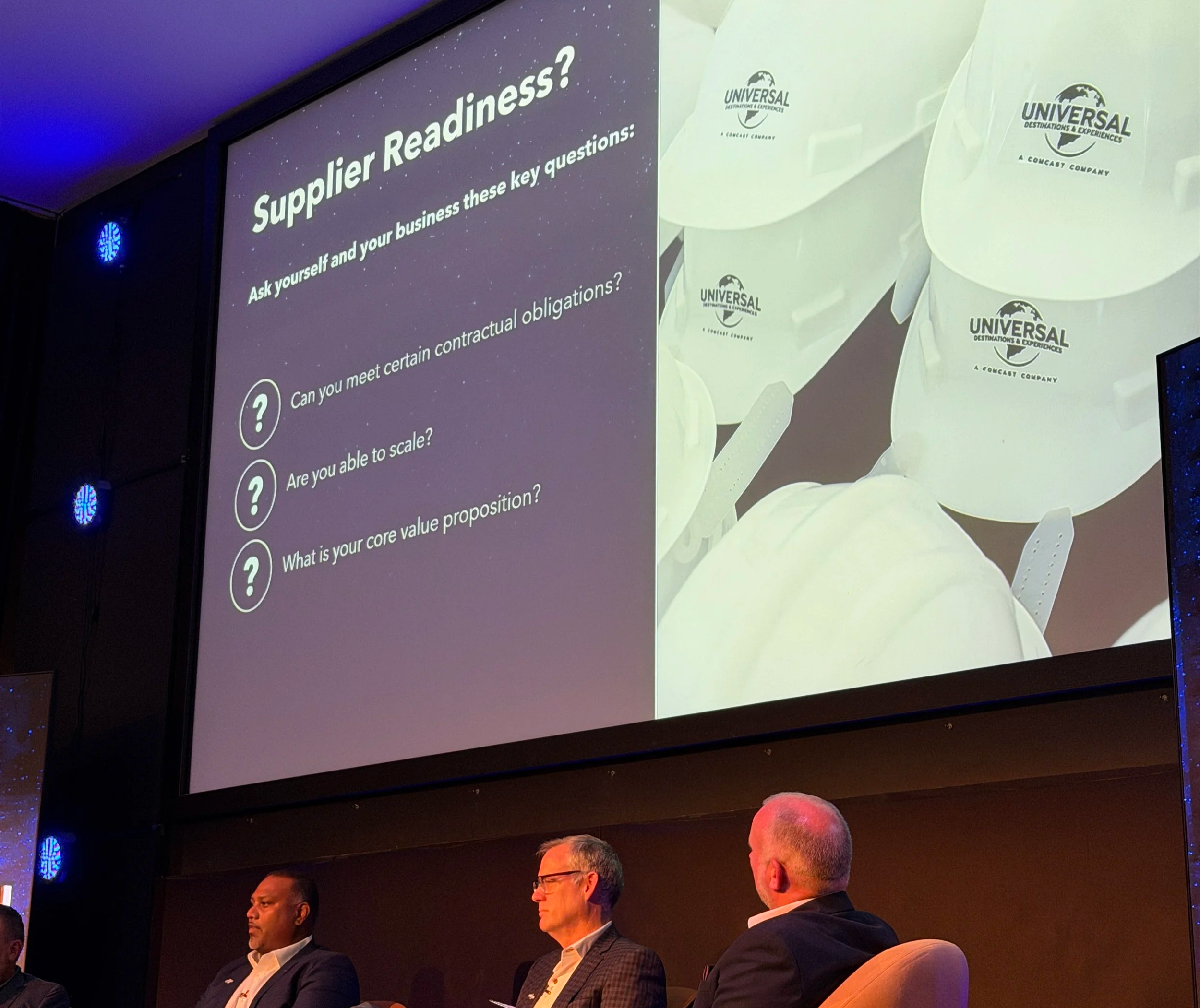
So it's just about that. And at a lot of these events John mentioned, suppliers often come alongside us in this community partnership. So think about your own readiness, and that of your organisation. Can you meet certain contractual obligations? Are you able to scale? What's your capacity for production — it's going to be tough.
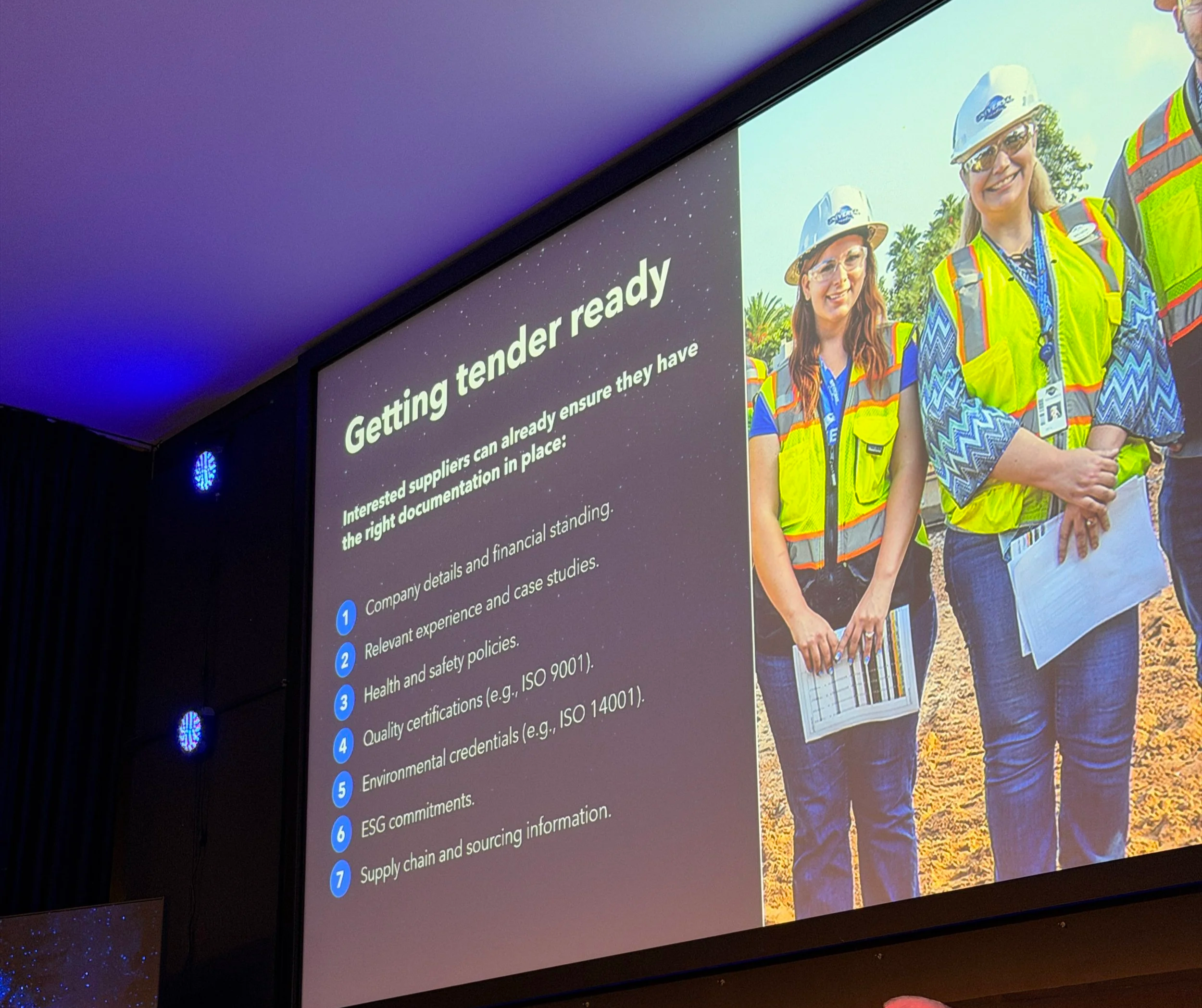
There'll be times when Russ's team will be working late into the night, working through situations, and we want partners who can support that. And of course — can you scale, and what's your value proposition? So, getting tender-ready — going through your financial standing, how you put together the best business case you can, drawing on case studies. As Russ said, we're a theme-park business, but we're also a retail business, and a food and beverage business, and for certain aspects of the park we look to third parties — so look through your certifications.
Operating safely is a core value of ours, as is minimising the supply chain's impact on the environment — and where you position yourself within a sourcing category. So, this is the QR code I mentioned — please give it a scan and register your information. As I said, we're spending a lot of time cataloguing this, to make sure we've captured everyone's interest, and every supplier, in our database.
And as we move through the tendering phase, we'll be reaching out to the suppliers who've registered interest, inviting them to tender, and learning more about their organisations. But more than anything, we're super excited to be here, super excited to partner with the people of Bedford and Bedfordshire, and we're really grateful for the support. There's no way we could do what we want to do without you. So thank you very much.
Looking forward to meeting as many of you as I can — feel free to scan the QR code and register your interest.
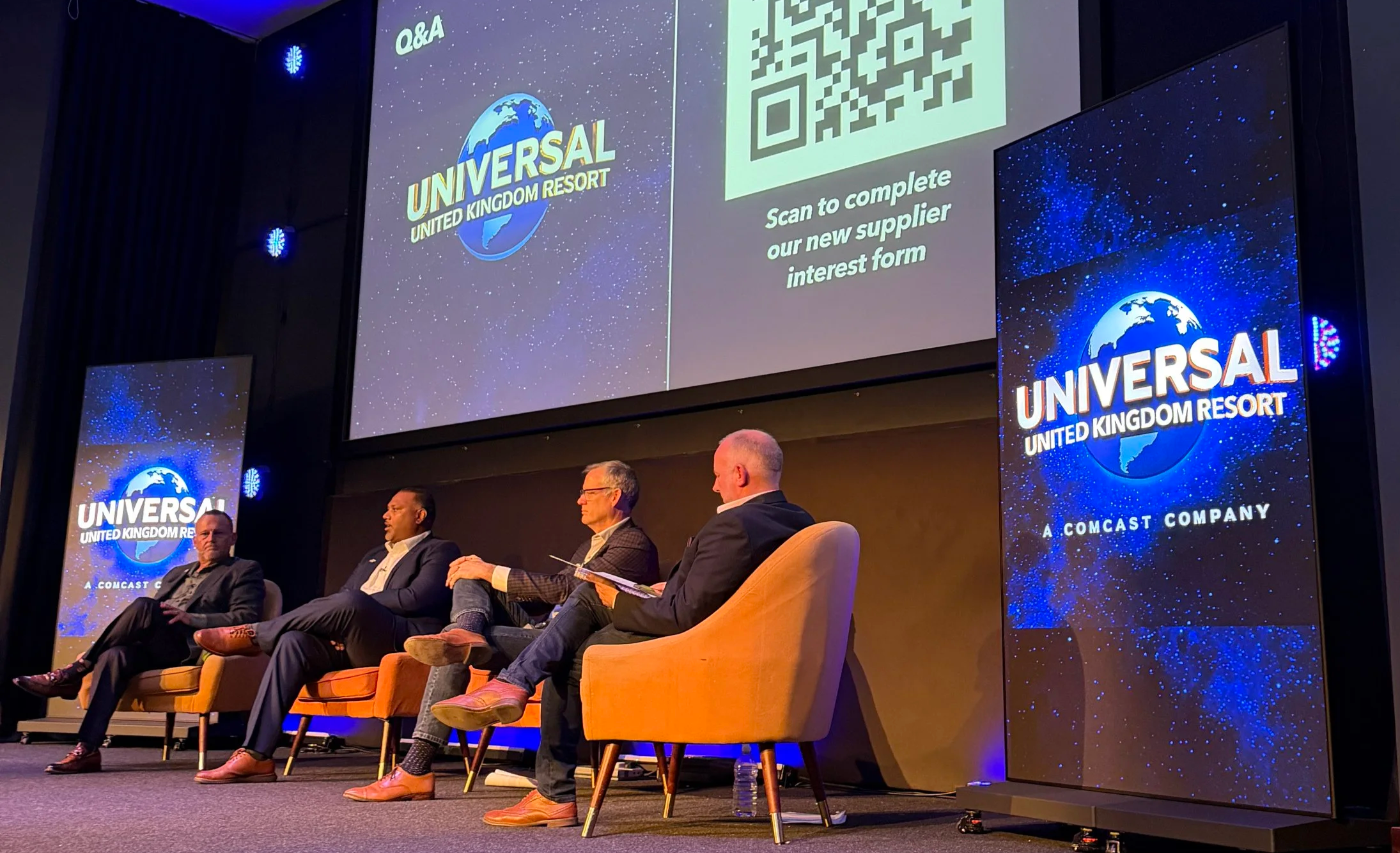
Q&A Session (moderated by Justin Richardson)
Right, I suspect you're going to be very popular in the networking session!
As you can imagine, given how exciting this project is, there's been a huge amount of interest — not just in a room of this size — and we've had a huge number of questions come through in advance. So I thought, to warm us up, I'd put a few of those to the panel first, and then we'll open it up to the audience. Is that okay with everyone?
So the first question, and one that keeps coming up quite strongly, is: can you give suppliers a sense of how the programme will develop over the coming years, and when different types of businesses or industries can expect relevant opportunities to emerge?
Russ Dagon: I'll start with the construction side, and then hand it over to Brad — but it's pretty traditional. We're already working on infrastructure, and we'll follow that with deep foundations, piling, and structural steel. So structure comes before everything else — structure and civils. It'll be like a campus development, similar to other big projects you may have worked on.
Brad Singer: From my side — the operations side, and what we're ultimately going to turn on — it's a slightly different process. But one thing I'd add is, as I mentioned, we've got this park split into zones, and we're developing it zone by zone. In order to make sure we're not handing over a product to Doug, that has five different mechanical units in every zone, and is stuck with an enormous spares inventory because they have to keep spares for everything — or God forbid I want to use a different valve or a different light fixture — we're trying to get consistency, and bulk-buy some of those packages up front, so we can hand pre-negotiated agreements over to our contractors and say, "Here's what we're using for lifts, here's the fixtures we're using," whatever it may be. So some of that comes earlier in the process, just from working with suppliers.
Russ Dagon: Yeah, so as Brad said, construction obviously comes early — but there'll also be a process where we start to identify operational suppliers, just to understand their capability. As we think about large-scale operations — things like resort transportation, food and beverage — we're going to need the scale of many organisations. So throughout the process, while we'll certainly focus first on construction and infrastructure, we'll also start to issue RFIs for certain operational categories. So typically, anything related to operations — food and beverage, retail logistics, resort transportation — are things we need to get ahead of. We do that as part of the commitment we mentioned earlier: we're not just going to say, "be ready," and hope for the best. That RFI and tendering process is how we understand the market, so we can help our suppliers get ready for us.
Moderator: On that point — a key thing that keeps coming through is around smaller, regional businesses. I understand there are around 400 businesses within a twenty-mile radius of the site in this room. What's the most effective route for those small and regional businesses to get involved in the project?
Universal panel: First: stay tuned to these supplier events — this isn't the first, and it won't be the last; we'll be running these throughout the project. But the first thing I'd say is, scan that QR code — we realise interest is huge, and we've got a lot of work to do, so that will be our primary mechanism for staying connected: sending out communications, and making sure you're on the right tender lists. And I'd say the website too.
Yeah, and I mentioned the prime contractors we're working with — all of them are actively looking for resources they can tap into. If you're not known to any of them, I'd say reach out — they're pretty easy to get hold of.
I'll add — a couple of the construction trade associations put out articles just today. We normally don't allow our vendor base to publicise that they're working on projects for us; we do that intentionally, because of the IP we're dealing with, and contractual rights around the development of the product, and so on. But we did something a bit different today: this morning, we put out a list of those who helped us through the SDO process, and a list of those who've been engaged so far — we did that intentionally, because we're ramping up so quickly here. That will help them attract their own sub-base too, in a timely way. So if you have any questions about that — in fact, I think we've put that list on our website as well, it's up there. So if you have questions about who those are, take a look there too. You won't see a lot of editorialising from those firms, because they need to follow an agreed script — we're very strict about that — but we wanted to give them the opportunity to let people know they're involved.
Moderator: Fantastic. Last question, and then we'll open it up to the audience — just an interesting one. How important is previous theme park or major project experience?
Universal panel: You know, I was thinking about some of the companies that have grown with us — there's a retailer that started with us and went on to own Billabong and did pretty well for themselves. They started as a small surf shop.
We have a contractor we work with who had only ever done parking garages before, and they wanted to show us a new product they had, that they thought could be useful in building hotels. They ended up building 11,000 hotel rooms for us because they sold us on the product, and it was very compelling — so we allowed them to grow alongside us, and it was mutually beneficial. So those are two examples of businesses that had never done anything like this before they worked with us.
When I look at what we do, I think of college campuses — when I walk around a college campus, I look at what goes into the infrastructure, the systems, and the facilities there, and it looks a lot like what we do. We had a hiring programme a few years ago where we brought in a number of retired military veterans looking to re-enter civilian life, and I remember thinking, "What do these guys know about what we do?" But as soon as we started talking, I realised they do the exact same thing, just at a different scale. Hospitals are another good example.
The thing that's really compelling about what we do — especially if you've worked in defence, hospitals, or prisons — is those are facilities you really don't want your kids hanging around in. You don't get to bring them there, and in some cases you really don't want them winding up there. We get to develop something you're proud to take your family to and show off. That's something that's really fun about this.
Moderator: Do we have any questions from the audience, please? Who's going to ask some questions? [aside] Could you get the microphones ready for that? Great, thank you.
Audience Question 1 — Izzy, Resolution
Hi there, my name's Izzy, I work for Resolution. When it comes to your network infrastructure and design, is that going to be handled by your own US team, or are you open to working with local firms here? I mean from a design standpoint, and also from a delivery standpoint — the delivery body and the network design.
Universal panel: Initially, we're working with vendors — it's not necessarily all US-based, because through our relationship with Sky, we've got a number of contacts, so it's both UK and US. On the delivery side, to be honest, we haven't got it entirely figured out yet — I'd love to sit up here and say we've got it all figured out, but we don't. Because of the industry you're in, it's a heavily regulated one, so my team probably gets a bit more involved — not just during construction, but also in the implementation of new technologies, given the different regulatory landscape here.
The reality is, certain things need to be done at the local level to understand the differences compared with some of the original planning we might do with vendors in the States. But really, a lot of it has to be done here on the ground. And it's important, because we're having to bring people up to speed on a regulatory environment they've never operated in before. So, great question — the answer is, it's definitely both.
Moderator: Great — I can see a hand went up quickly after that. Let's take two in the middle, and then one over there. Thank you.
Audience Question 2 — Tom Lennon
Tom Lennon, [company name unclear]. As a five-year-old, my mum and dad took me to Universal, and it was incredibly inspiring, and it's stayed with me my whole life. I'm wondering — to what extent do you try to use that power to educate the local community, particularly around how you'll integrate education and inspiration for young people, so that they come back to it in future?
Universal panel: That's a great question, and I'll tell you why — we hold ourselves to certain standards for how we build in the UK. In America, that's LEED certification, and we only ever go for one of the top levels of the LEED spectrum. Our entertainment resort complexes around the world will always hit a certain level of LEED certification. So, energy sources and so on are an important factor for us. It's part of our commitment — the UK unit, as well as Comcast and NBCUniversal more broadly, are both focused on alternative energy sources, and on how we feed that back to the grid, and make things more sustainable. So the answer is, yes, we set ourselves aggressive goals in that area, so we can achieve that certification.
I will say that we are working on community outreach and a lot of those programmes right now — it's under development. Thank you.
Audience Question 3 — Raj, Sugar and Spice Bakery Kitchen
First of all, I just wanted to say thank you so much for choosing Bedford — I'm a Bedford boy, born and bred, and I'm incredibly excited about this opportunity. Secondly, I'm interested in the food and beverage side of things — I have a small, independent local business — and I really wanted to understand: will there be an opportunity for a small, local brand to have some kind of floor space within the resort?
Universal panel: Yeah, I'd say absolutely — we've got a variety of case studies on just that, in fact. I would say, though, that food and beverage is typically an area that comes into play a couple of years into the project. But we'd certainly love to see what you can offer, and look at how we integrate it in. I don't think there'll be any shortage of opportunities in food and beverage. Thank you.
Audience Question 4 — Cindy, developer
Hi, my name's Cindy, I'm a developer. I have a question regarding accommodation. Outside of the on-site hotel accommodation, based on your experience and anticipated need, can you quantify the level of accommodation you'll need in the surrounding area, and the type of accommodation needed?
Universal panel: Happy to answer that. As we develop a park, we never build enough hotel rooms on-site to meet all the demand ourselves — we know there will be accommodation needs in this community. I think a lot of people have already approached the community and the council about what those opportunities might be. Given the planning approval timelines here, people are already trying to work out what it will take. And on our side, there will always be a combination of development factors.
I think you'll also see many existing places in this community go through renovations or expansions. It's a chance to make accommodation more robust for this community. And that's not just for us — when you also factor in things like the expansion of Luton Airport, and all the additional businesses that will come into this community because of the size and scale of our project.
And think about this: we're effectively building the equivalent of a small town, that at any given time could have 50, 60, 70,000 people in it. That's the order of magnitude of what will happen every single day. When we talked to the government about why they wanted to back this, the answer that came back was: think about a Premier League match happening in your town, 365 days a year. That's what we're talking about.
So accommodation will be needed — exactly how that's defined is going to be up to the community. I would add — in Orlando, which has a very established network of parks, we've got a lot of hotels, about 11,000 rooms, but we also have relationships with neighbouring hotels — partner hotels. So that's obviously an opportunity if you're a hotel developer; we've done that in Japan, and I believe in Hollywood as well. So that's another avenue.
Audience Question 5 — Research psychologist
I'm a research psychologist, and I'm interested to know how you're bringing children's voices into the development, and how you're working with kids and families to understand the play value and benefit, and to bring the community along.
Universal panel: I think — we will have a very aggressive CSR programme, working with the community. Again, we like to focus on where our employees work, live and play. There's a saying in our company, and it starts with the team members: TSAT — Team Member Satisfaction — equals GSAT — Guest Satisfaction — equals a fair return.
What does that mean? We're going to invest in the community, and we're going to invest in our staff. One example I always bring up — we tend to use one particular neighbourhood as an example, because we like to study the microcosm — there was a period when a lot of our hourly workers were coming from one specific area. And we got a report that the key elementary school in that community had received a failing grade two years in a row. And we said, "That will not stand" — that's where our employees are coming from, and they're worried about what's happening to their children. So we said we're going to adopt this school, and put some resources into it. I, along with many of our staff, went in and mentored students, and read with them, and in one year — just one year — we took that school from an F to an A rating.
So those are the kinds of things we're going to look at in this community — we're going to study the needs of the community and the needs of our employees. Now, I understand there's excitement for Universal to get involved immediately, but we first need to have an operating product here — so, on some of this, I'd say please be patient.
[Colleague] knows that one of his responsibilities is to stand up the CSR programme, and it has to be very robust.
I would say, though, from a product and creative standpoint, our Kids Resort in Frisco was our first kids' park, and it was designed entirely through the eyes of children — ages three to ten. This park is a little more — I don't want to say "adult" — but with the IPs we're working with, and knowing how we're designing things, it's built so that a family uses the park and works through it together as a group. It's not, "hey, teenagers go over there, and we'll take the young kids over here" — each zone is designed for the whole family.
Going back — just thinking about LEGO as a child — if you walk through our creative offices, everyone there played with LEGO growing up. Some of us remember when LEGO was free play: you were just given different-coloured bricks, and you figured out what you were going to make. And then it evolved into building a spaceship, or a wizarding world, or whatever it is. We have free-play areas in the park that aren't as IP-heavy — they're still IP-driven, but they're free play, and kids interact with them. So the scale of it is: we're going to take you on a wildly immersive ride, and then there are other parts of the park that are more like a really nice, amped-up, ridiculously clean version of what you might find in a city park. So there's a bit of everything.
I'm not sure if that fully answers your question, but we do work with researchers on this — we're working right now with a kids' play company here in the UK that has developed a lot of the products you'll see in your local parks. All of our employees go through training on this. One example I always give is around how we take autism into consideration — sensory relief areas, and so on.
There was an autistic child whose dream was to ride the Spider-Man ride. He's in line, and the ride comes to an emergency stop — which happens now and then, just for the technicians to check something — but try telling that to an autistic child. Now, as it happens, at the end of every one of our rides, you always come out through a gift shop. So this child was inconsolable — on the ground, having a complete meltdown. And this 22-year-old employee actually lay down on the floor next to him and said, "I'm getting paid by the hour — I can be here as long as you are. And when you're ready to stand up, I'll help you up." The parents were mortified, but the employee said, "It's okay, don't worry about it." When the child stood up, the employee — who knew she was empowered to make a difference — said to him, "Pick anything in this room." He picked an $8 notebook, and she knew she wouldn't get in trouble for it.
What we didn't know is that another parent, of another autistic child, was in the store at the time, filming the whole thing — and it went viral. Three million views later, it was clear we'd simply done the right thing.
So, yes, we're going to look closely at the reality of the community, at its needs, and focus there. We've got time for one more. There was one right at the back that was quickest — put your hand up.
Audience Question 6 — development director, Prudence Homes
[Audience member], development director for Prudence Homes. I'm from the city next door. My question is slightly different: we're in the business of providing accommodation as well. There are two phases to the project, I think — one is while you're constructing, and the other is once it's operational. What are your accommodation needs now, for contractors and for employees coming from abroad? And how can I get in touch with someone in the government about this?
Universal panel: First thing — please find me afterwards. But yes, we do have immediate accommodation needs for our contractors, and, of course, longer-term housing needs for around 8,000 people once we're operational. Some of those people are probably already in this room, or already housed in the area. Contractor housing is something we're working on with the prime contractors, as well as our GC firms, to figure out how to address it immediately.
So, yes, we definitely need to work on this. And let me tell you — when we were working on the deal with DCMS, our sponsoring department down in London, accommodation was one of the critical factors. We had to show that we believed there was enough accommodation — which means we have to work aggressively with the community and with the contracting community. And there's an obligation on us to provide accommodation on-site ourselves, if we don't hit certain levels of accommodation being available locally. But one thing — we've deliberately given that opportunity to the community; there is some accommodation available. So the reality is, we want to work with you. We're motivated to do this.
Moderator: I think that's a great place to end the questions for now. Can we take a short pause?
Closing Remarks — Justin Richardson
Right, so we've got about 45 minutes now for networking. I've been told this has to finish strictly by 6.45 — the last time I tried to get people out of one of these, it was nearly midnight! So please be respectful of the time.
Members of the Universal team will be around, as pointed out — we've also got some general contractors here in the audience today; you'll be able to spot them by the pale blue badges around their necks. And one thing I'd like to add, from earlier — please don't be discouraged if you don't get to meet someone from Universal today. This is the first of many events to come: forums, round tables...
[Transcript ends here as the recording moves into the networking session.]
