The Managed Backbone: A Deep Dive into High-Density Resilience
By Brendan Mills, National Business Development Manager, SCCI Alphatrack
In a private MDU, the resident is the customer of the ISP. But in Student Accommodation (PBSA), Later Living, and Managed BtR, the resident is the customer of the landlord. When the Wi-Fi drops, it isn't a third-party call center that gets the heat—it’s the Estate Manager.
Drawing on the RISE values (Respect, Integrity, Service, Excellence) I’ve carried from my RAF service, I believe in designing managed networks that don't just "work"—they endure. To do that, we move beyond commodity hardware and into the engineering of RUCKUS Networks.
1. BeamFlex+: The "Agile Spotlight" vs. the "Static Lightbulb"
In a managed environment like a 500-bed student block, the biggest performance killer is Self-Interference. Traditional omnidirectional antennas blast signal in all directions, creating a "fog" where every Access Point (AP) is shouting over the other.
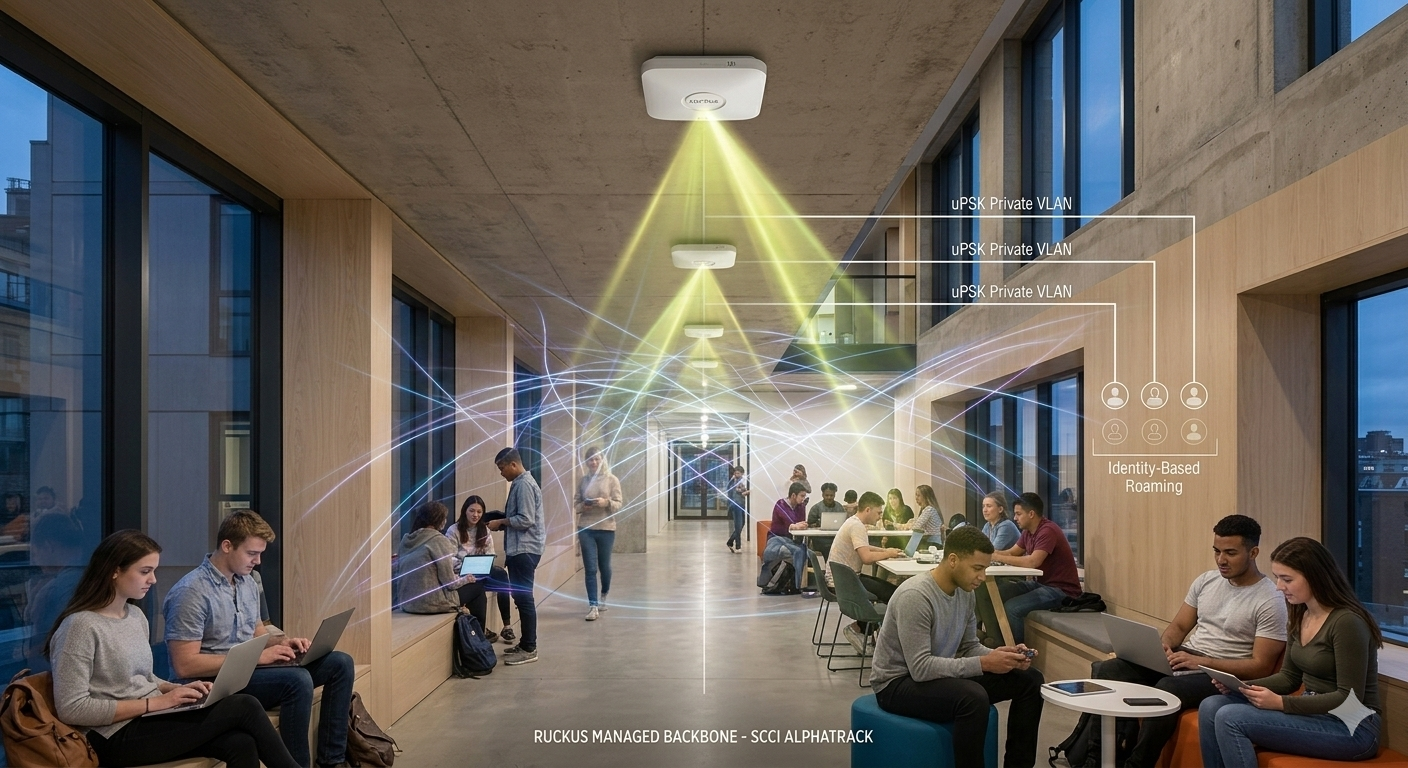
RUCKUS uses BeamFlex+, a smart antenna array that focuses energy only where it’s needed.
How it works: Think of a standard AP as a lightbulb in a dark room—it wastes energy hitting the walls and ceiling. RUCKUS is a spotlight. It uses an agile antenna array to steer the signal directly to the resident’s device.
The "Signals" Advantage: By dynamically choosing the best path among thousands of antenna patterns, RUCKUS mitigates interference and increases signal gain by up to 6 dBi. For the landlord, this means more stable connections in "dead zone" areas like en-suite bathrooms or deep within reinforced concrete structures.
2. ChannelFly: Machine Learning for the "Friday Night Peak"
In my time at 90 Signals Unit, we learned that the radio environment is never static. In a PBSA block on a Friday night, the airwaves are chaotic.
While most systems use "Background Scanning" (which briefly drops the connection to check for better channels), RUCKUS uses ChannelFly.
Real-Time Intelligence: ChannelFly uses machine learning to assess the actual throughput capacity of all available channels.
Proactive Switching: It doesn’t just look for "interference"; it looks for capacity. If a channel is "noisy" but moving more data, it stays. If a "clean" channel is actually congested, it moves. This ensures that a resident’s gaming or telehealth session remains lag-free even as their neighbors all start streaming 4K simultaneously.
3. Identity-Based Roaming (DPSK)
In a managed network, security often creates friction (think of those annoying "Captive Portals" where you have to log in every 24 hours).
We design our managed services with Dynamic Pre-Shared Keys (DPSK).
The "Home" Feel: Every resident gets their own personal password. This places all their devices—phone, laptop, PlayStation, and even smart speakers—into their own Private VLAN.
The Results: Neighbor A cannot see Neighbor B’s printer. Yet, a resident's network "follows" them. They can start a video call in their room and walk to the communal gym or study lounge without ever dropping the connection or needing to re-authenticate. This is Service and Excellence in action.
4. The Commercial Reality: ROI and Reliability
As a National BDM, my role is to ensure Integrity in the project's budget. While RUCKUS hardware has a higher initial CAPEX, the Total Cost of Ownership (TCO) is significantly lower in managed environments:
Fewer APs: Superior coverage often means you can reduce the AP count by 15-20% compared to "budget" brands.
Lower OPEX: Our cloud-managed platform allows SCCI to fix 90% of issues remotely. This eliminates "Truck Rolls" (engineer site visits), saving the landlord thousands in annual maintenance.
Reputation Protection: In PBSA, a 1-star review about "Bad Wi-Fi" can drop occupancy rates by 5-10% in a single season. RUCKUS is "Reputation Insurance."
The Bottom Line
Whether it's ensuring a student can submit their thesis or a Later Living resident can stay connected to family via video, the managed network is the building's most critical "Life Support" system. At SCCI Alphatrack, we don't just "install Wi-Fi." We engineer resilience using the best tools in the world.